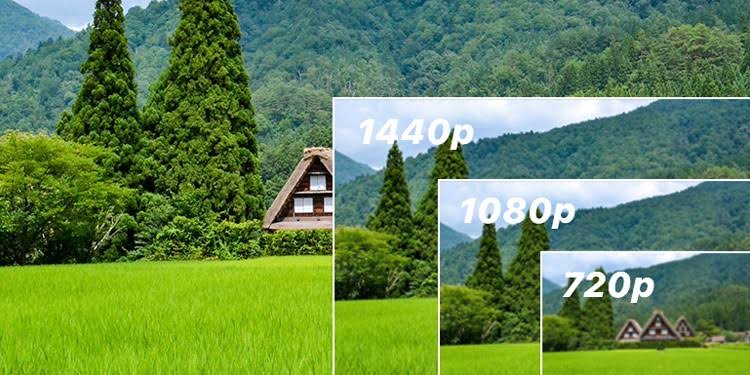
In practice, there’s no perceptible difference between the resolution of a 720p display (720×1280) and a 1080p display (1080×1920).
A screen with a 5 inch (12.70 cm) diagonal, and the typical square-pixel aspect ratio of 16:9, measures about 2.45 inch × 4.36 inch.
Thus the pixel density of this screen at 720×1280 would be about 293 DPI, and about 440 DPI at 1080×1920.
Many sources cite 300 DPI as around the upper limit of perceptible resolution for a handheld LCD screen, for a person with 20:20 vision. That means a 1280×720 screen is already at the limit of resolution perception. (I should mention Michael Gordon’s interesting answer, which argues for a significantly higher limit of perceptible resolution.)
Personally, I agree with 300 DPI as an upper limit. I have somewhat better than 20:20 vision and I use two Android smartphones with 5″-diagonal screens, both IPS LCDs: an older higher-end phone with a 1920×1080 display, and a newer low-end one with a 1280×720 display. I do not perceive any difference between them unless I squint very hard at graphics contrived to identify pixel-level features.
Did I say there’s no difference at all between 720p and 1080p smartphone displays? Not quite true…
- a 720p display is cheaper to manufacture,
- a 720p display uses less power on multiple levels: less CPU/GPU power to draw ~55% fewer pixels, 55% less RAM to store a frame buffer, slightly simpler driving circuitry overall, and perhaps most importantly…
- a 720p display can achieve comparable brightness with a lower level of backlight power because less of the screen area is occupied by the dark mask or grid separating adjacent pixels, which is necessary to form a sharp image with most types of screens.
In summary: 720p displays are superior for smartphone-sized screens. 1080p displays are a waste of money and a waste of battery life for no perceptible effect.
I’m surprised no major smartphone manufacturer has come out and marketed a smartphone with a 720p display by trumpeting all of the aforementioned virtues of a screen with an appropriate resolution. ¯\_(ツ)_/¯
The difference is basically of the pixel density of the display. Let’s consider a phone with screen size of 5″. If it’s a 720p display then the number of pixels along the length will be 1280 and along the width would be 720. Thus giving a pixel density of approx 330 ppi.
If the same display then was to have a resolution of 1080p then the pixels would be 1920×1080. This giving a pixel density of approx 440 ppi. The higer number of ppi makes the display look more sharp, detailed and undistorted.
The other difference it would make will be in the resolution of the screenshot. The resolution of screenshot will be same as that of the display. If the size of the screen increases them the pixel density will reduce keeping in mind the fact that number of pixels across the display are the same.
Screen resolution and display size: are we there yet?
Let’s first start with the iPhone 4, a smartphone that first claimed it comes with a ‘Retina’ display so sharp that the eye of a regular person no longer sees jagged pixels. The iPhone 4 was a device with a resolution of 640 x 960 pixels, but resolution alone does not tell us much about the sharpness of the display itself. After all, if you put the same resolution that looks clear on the iPhone on a 50-inch screen it would suddenly start looking not sharp at all. So instead of looking at resolution alone, it makes much more sense to look at a metric like pixel density, calculated using both screen size AND resolution.
The iPhone 4, for instance, featured pixel density of 326 pixels per inch (ppi, but some would also say dots per inch, or dpi).
Not long after, though, higher resolutions and pixel densities started to appear. Here are the pixel densities of some popular phones since then:
- Apple iPhone 4-5s: 326ppi
- Samsung Galaxy S3 (4.8-inch, 720p): 306ppi
- Samsung Galaxy S4 (5-inch, 1080p): 441ppi
- Samsung Galaxy Note III (5.7-inch, 1080p): 386ppi
By looking at these different phones, we can again see how screens with the same resolution have different pixel densities, and thus different sharpness.
Back in the day when Apple unveiled the iPhone 4, various reports suggested that anything above roughly 300ppi is good enough for the human eye to perceive as clear and sharp. Why then screen resolutions continued growing and growing until present-day Quad HD devices?
The latest Quad HD smartphones come (or are expected to arrive) with a pixel density as high as (the seemingly unnecessary) 534ppi! Is it really just new technology for nothing?
The third factor: viewing distance
There is another key factor that should be considered when we speak about display sharpness and clarity, though, but it’s often left out of the conversation. We’re speaking about viewing distance. Even the sharpest of TVs and the sharpest of phones starts to look flawed when you look at it from a very close distance. Look at the same device from a 1-foot distance and the clarity of the picture suddenly becomes better. Look at it from further away, and the picture would appear perfectly sharp and clear.
The question that we will answer today then is: at what viewing distance one starts actually seeing the benefit of high-res displays?
The ideal viewing distance
To measure the ideal distance between you and your smartphone display, we’ll assume you are one of the rare few who have very good vision. You’d often hear about such vision being called 20/20 vision. A person with 20/20 vision is one who can discern detail of 1 arc minute (1 arc minute = 1/60 of a degree = a circle has 360 degrees, so 1 arc minute = 1/21600th of a full circle). Most people have worse vision than that – for instance someone with 20/40 vision can only discern detail of 2 arc minutes, while the rear few (think jet pilots) with 20/10 vision can discern detail of 0.5 arc minutes. The actual limit of human vision is around 20/8, so again, we’re assuming a fairly optimistic 20/20 vision scenario.
So with all that in mind, how close do you need to be start seeing those pixels and details on even a Quad HD smartphone? And what about 1080p phones, and 720p devices? Take a look below:
- Typical 480p phone (4” display like Galaxy S III Mini): eye starts to notice pixelization from 14.73” (37.4cm)
- Typical 720p phone (4.7” display like Nexus 4): eye starts to notice pixelization from 11” (28cm)
- Typical 1080p phone (5” display like Galaxy S5): eye starts to notice pixelization from 7.8” (19.8cm)
- Typical 1440p phone (5.5” display like expected LG G3): eye starts to notice pixelization from 6.44” (16.4cm)
480p, average person starts noticing pixelization at around 14.7 inches (here – 37.4cm) in a 4-inch 480p phone
720p, average person starts noticing pixelization at around 11 inches in a 4.7-inch 720p phone
1080p, average person starts noticing pixelization at around 7.8 inches in a 5-inch 1080p phone
Quad HD, average person starts noticing pixelization at around 6.44 inches in a 5.5-inch 1440p phone
*I’ve used the following formulas to calculate those distances:
VIEWING DISTANCE = 1 / PPI / (2 * Tan (VISUAL RESOLUTION / 2))
PPI = X / sqrt (W ^ 2 / ((Y / X) ^ 2 + 1))), where x = horizontal resolution, y = vertical resolution, w = screen size
VISUAL RESOLUTION = (1 / VISUAL ACCUITY) * (1 / 60)
We’ve assumed 20/20 VISUAL ACCUITY
Conclusion
In conclusion, I ought to put a few disclaimers to all this. I’ve tried to keep it as scientifically accurate as possible, but we ought to remember that our eyes and our human vision is more complex and the actual way we see things is a lot about how the brain processes images. And that’s something that is hard to measure right now.
With this in mind, I’ll lay it out in very simple terms: theoretically, you need to look at your 5.5-inch Quad HD from as close as 6.4″ for your eyes to start noticing pixelization (if you have 20/20 vision, if not you’d need it even close). At regular viewing distances it’s practically impossible to notice the difference in sharpness between say the 1080p Galaxy S5 and the future Quad HD flagships.
Not very encouraging, is it. Stay tuned for more reviews, how to’s and much more.
8

Mayson is a communication and media technology student with a passion for tech and automobiles including all surrounding factors of the aforementioned
 Mays Tech Talk